For most of human history, there was a fairly simple limit to how much work could be done.
There were only so many hands available to lift, pull, spin, weave, dig or carry. Animals could add strength. Rivers could turn waterwheels. Wind could move ships and mills. Fire could provide heat. Human ingenuity had already produced remarkable tools and machines, but productive power remained closely tied to nature and muscle.
If a farmer wanted to cultivate more land, more people or animals were usually needed. If a weaver wanted to produce more cloth, more time or more hands were required. If goods needed to travel across a country, horses, carts, rivers and roads determined how quickly they could move.
The world could improve its tools, but it could not easily escape the physical limits of the energy available to it.
Then something changed.
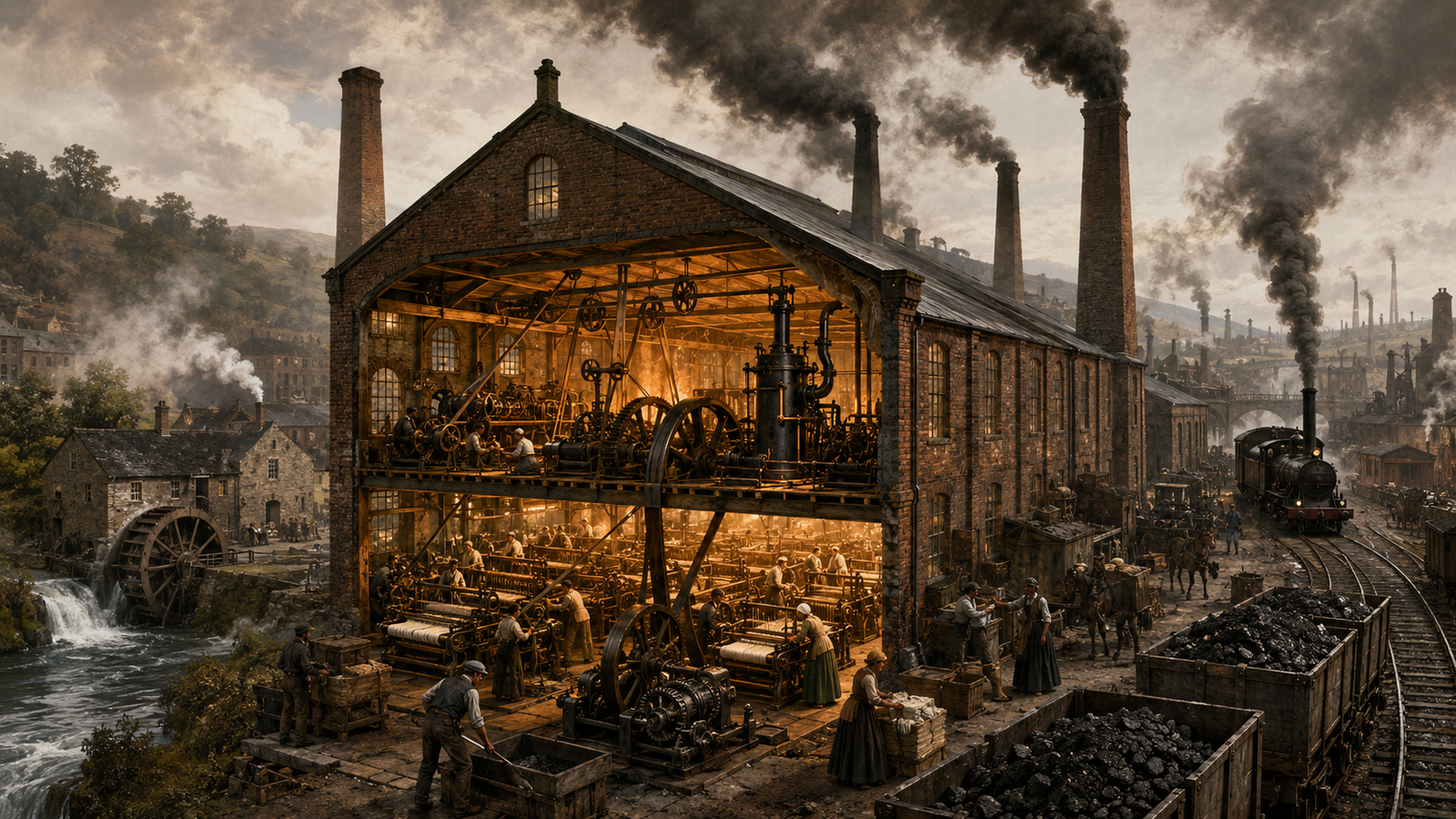
Beginning in Britain during the eighteenth century, a series of innovations in textiles, mining, iron production and mechanical engineering began to reorganise production. Machines became larger. Workshops became mills. Mills became factories. Coal became increasingly important as a source of energy. And eventually steam allowed industry to produce mechanical power almost wherever sufficient fuel and water could be supplied.
The First Industrial Revolution had begun.
Its greatest achievement was not simply the invention of new machines.
It was the discovery that machines could multiply human muscle on a scale civilisation had never previously experienced.
The World Before Steam
The industrial revolution did not begin with James Watt suddenly inventing the steam engine.
That version of history is attractive because it gives us a single inventor and a single machine, but technological revolutions rarely happen that neatly.
The textile industry was already being transformed by mechanisation. Machines such as Richard Arkwright’s water frame enabled cotton spinning to take place at much greater scale, and some of the earliest mills depended heavily on flowing water for their power. The rivers of northern England therefore became part of the geography of early industrialisation.
That represented enormous progress, but it also revealed a limitation.
Water power was powerful only where the geography allowed it.
A factory dependent on a river had to go where the river was. Water levels could vary. The availability of energy remained tied to location and natural conditions.
Steam gradually changed that relationship.
In 1712, Thomas Newcomen developed a practical atmospheric steam engine that could pump water from mines. Mining had a serious problem. The deeper miners went, the more groundwater they encountered. Removing that water by conventional methods was difficult and expensive. Newcomen’s engine offered a mechanical solution.
It was inefficient, but that mattered less in coalfields where fuel was readily available. More importantly, it demonstrated a revolutionary principle. Useful industrial power could be generated by burning fuel rather than depending entirely upon muscles, wind or flowing water.
What began as a solution to a mining problem would eventually help change almost everything.
Steam Became Practical Power
James Watt entered this story decades later.
While working with a model of a Newcomen engine, Watt became interested in the enormous amount of energy it wasted by repeatedly heating and cooling its cylinder. His crucial improvement was the separate condenser, patented in 1769, which allowed steam to be condensed away from the main cylinder.
The improvement dramatically reduced fuel consumption. According to the Science Museum, engines using Watt’s condenser could burn roughly two thirds less coal than earlier designs. That made steam power economically useful in a much wider range of settings, including factories, mills and workshops.
Watt and his business partner Matthew Boulton subsequently developed steam engines further, including designs capable of producing rotary motion suitable for driving industrial machinery.
That mattered enormously.
Pumping water from a mine was useful.
Turning the shafts, belts and machinery of a factory was transformative.
A manufacturer was increasingly able to obtain mechanical power when it was required rather than merely where nature provided it. Steam did not eliminate water power overnight, and industrialisation continued to depend upon many technologies working together. But it gradually loosened one of the oldest constraints on productive activity.
Power was becoming something that could be generated.
That seemingly simple development changed the economics of production.
The Factory Became a New Kind of Machine
The factory is sometimes described merely as a large building containing machinery.
It was more than that.
The factory itself became a system.
Machines, energy, workers, raw materials and time were organised around a continuous production process. Work that had previously been distributed across households and small workshops could be concentrated in one place.
Textiles demonstrate the transformation particularly clearly. Manchester and the surrounding region became synonymous with industrial cotton production as spinning and weaving became increasingly mechanised. By the early nineteenth century, large steam powered mills had become prominent features of the industrial landscape.
The consequences were not merely mechanical.
Work itself changed.
A craftsperson working from home had considerably more control over the rhythm of the working day. Factory production demanded something different. Workers had to arrive when production began. Machines established the pace. Tasks became increasingly specialised and repetitive. Time itself acquired greater economic importance because an idle machine represented wasted productive capacity.
The worker was no longer simply using a tool.
The worker increasingly became one part of a larger production system.
That principle would outlive steam.
Modern assembly lines would refine it.
Computers would digitise it.
Artificial intelligence may now extend it into intellectual work.
Industrialisation Changed Distance
The same source of power that transformed factories eventually transformed transportation.
Steam engines were adapted for locomotion, and railways began changing the relationship between place, time and markets.
Before rail transport, moving large quantities of goods over land was slow and expensive. Roads could be poor. Horses required food, rest and care. Water transport was highly useful but geographically constrained.
Railways introduced something different.
The Liverpool and Manchester Railway, which opened in 1830, became an important connection between the international port of Liverpool and industrial Manchester. Cotton and other freight could move between the port and manufacturing centres more quickly and reliably. The Science and Industry Museum notes that journeys between the two cities that had previously been unreliable and could consume much of a day were dramatically shortened by steam powered rail travel.
This enlarged markets.
A factory was no longer producing principally for the people living around it. Raw materials could travel greater distances towards centres of production, while manufactured goods could travel outward towards increasingly distant consumers.
Industrialisation was becoming a network.
Mines supplied coal.
Ports received raw materials.
Railways moved goods.
Factories transformed those materials.
Merchants distributed finished products.
Banks financed expansion.
Cities supplied workers.
Each technological improvement strengthened the others.
That is one reason industrial revolutions are so powerful. They are rarely about one invention. Their real force appears when technologies begin reinforcing one another.
The Revolution Was Global Before the World Called It Globalisation
There is also a less comfortable part of this story.
The factories of industrial Britain cannot be understood entirely by looking at Britain.
Manchester’s cotton mills required enormous quantities of raw cotton. Much of that cotton came through global trading networks, including plantations in the Americas and Caribbean where enslaved Africans and their descendants were forced to labour. The Science and Industry Museum has explicitly incorporated these connections into its account of Manchester’s industrial history.
The industrial revolution was therefore entangled with older systems of empire, commerce and exploitation.
Machines could increase the efficiency of spinning and weaving in Britain while the raw material entering those machines had been produced under brutal conditions elsewhere.
This matters because technology is never deployed in an economic vacuum.
Who owns a technology matters.
Who supplies its raw materials matters.
Who performs the labour around it matters.
Who receives its profits matters.
These questions remain surprisingly familiar today as the world debates who owns artificial intelligence systems, who supplies the minerals and energy behind modern computing, whose data trains AI models and where the economic benefits ultimately accumulate.
New technology changes.
Questions of power endure.
Progress Came With a Human Cost
For factory owners and consumers, mechanisation could produce extraordinary benefits.
For workers, the experience was more complicated.
Industrial factories were frequently dangerous, exhausting and poorly regulated. Children were widely employed. UK parliamentary records show that in 1800 about 20,000 apprentices were working in cotton mills and that during the following decade children under thirteen may have constituted as much as a fifth of the industry’s workforce. Early legislation attempted to restrict abuses, but enforcement was initially weak.
The Factory Act of 1833 marked an important development by prohibiting factory work for children under nine in the industries it covered, limiting working hours for older children and creating a small system of factory inspectors. Even then, enforcement remained difficult.
This is one of the recurring patterns of technological change.
Innovation tends to move quickly.
Institutions tend to follow.
The machine arrives first.
Society then begins negotiating the rules around it.
Industrial Britain had to confront questions about working hours, child labour, workplace safety and the obligations of factory owners only after industrialisation had already transformed working life.
The same sequence is visible today.
AI systems are being deployed while governments, courts, companies and societies are still debating privacy, copyright, employment, accountability and regulation.
History does not repeat itself perfectly.
But it does occasionally reveal familiar rhythms.
The Luddites Were Asking a Serious Question
Few groups from the First Industrial Revolution have been misunderstood as completely as the Luddites.
Today, calling someone a Luddite normally means accusing them of irrational opposition to technology.
The historical reality was more complicated.
The Luddites were largely textile workers confronting changes that threatened established occupations, wages and working practices. Many were skilled craftspeople who had spent years learning their trades. They were not simply frightened because machines existed. They were concerned about how employers were using machinery to replace skilled labour, reduce wages and reorganise production.
Their protests became violent. Machinery was destroyed. The British state responded harshly, including by making some forms of machine breaking a capital offence.
But underneath the conflict was a question that has never disappeared.
What happens to a worker when a machine suddenly makes the worker’s skill less valuable
That question belonged to the textile worker in 1811.
It belonged to agricultural labourers confronted by mechanisation.
It later belonged to factory workers facing industrial robots and clerical workers confronting computers.
Today it is being asked by programmers, designers, writers, accountants, translators, lawyers and other knowledge workers watching artificial intelligence perform tasks that previously required trained human beings.
The technologies are completely different.
The economic anxiety is remarkably familiar.
Technology Changes the Value of Human Ability
This is perhaps the most important lesson of the First Industrial Revolution.
Machines did not simply replace people.
They changed which human capabilities had economic value.
Industrialisation destroyed some occupations, reduced demand for others and created entirely new forms of employment. Engineers, machinists, factory managers, railway workers and industrial entrepreneurs occupied roles created or dramatically expanded by the new economy.
Productivity increased.
Markets grew.
Manufactured goods became available on scales that earlier generations could scarcely have imagined.
But those benefits were not distributed evenly, and they did not arrive without disruption.
That is why the history of industrialisation offers neither comfort nor justification for technological panic.
The lesson is not that machines inevitably destroy human employment.
It is not that technology automatically creates prosperity for everyone either.
The lesson is that technological revolutions reorganise economic value.
And once that process begins, individuals, businesses and governments must adapt to a world in which old assumptions about work may no longer hold.
The First Revolution Never Really Ended
We sometimes speak about industrial revolutions as though one ended and the next began.
Reality is less tidy.
Steam engines have largely disappeared from modern production, but the industrial logic they helped establish remains everywhere.
Modern factories still organise energy, machinery, labour and time around productive systems.
Global supply chains still move raw materials towards centres of production and finished goods towards markets.
Modern economies still depend upon concentrated sources of energy.
Workers still adapt when machines acquire new capabilities.
The First Industrial Revolution therefore left us more than factories and railways.
It established a new relationship between human beings and technology.
For most of history, human beings had created tools that helped them perform work.
Industrialisation demonstrated that machines could increasingly perform the work themselves.
At first, that transformation was overwhelmingly physical.
Machines could lift more.
Pull more.
Spin faster.
Weave faster.
Pump more water.
Move heavier loads.
Travel farther.
Human muscle ceased to define the upper limit of productive power.
And once humanity learned that machines could overcome the limitations of the body, the next question was inevitable.
How much further could machines go?
The Second Industrial Revolution would provide part of the answer.
Steam had given industry power.
Electricity would give it scale.
Next in The Trend Report
Electricity Changed the Industrial World
Mass Production Created Modern Industry
Resources
The historical account in this article was checked principally against the Science Museum Group and Science and Industry Museum collections on steam power, textiles and James Watt, UK Parliament’s records on nineteenth century factory regulation, and the United Kingdom National Archives material on the Luddite movement.