The steam engine had changed what a machine could do.
By the middle of the nineteenth century, factories could command amounts of mechanical power that would have been impossible a century earlier. Railways carried people and goods across expanding industrial economies. Coal powered mines, mills, ships and locomotives. Cities grew around factories whose chimneys had become symbols of a new age.
Human muscle was no longer the principal limit on productive power.
But the industrial system created by steam still had limitations.
Walk into a large nineteenth century factory and the machinery might appear impressive, but look above the workers and another part of the system became visible. Long rotating shafts ran through the building. Belts and pulleys carried mechanical power from a central steam engine to individual machines. The arrangement worked, but it also dictated where machines could be placed. Power had to travel physically through the factory.
Production had become mechanised.
It had not yet become truly flexible.
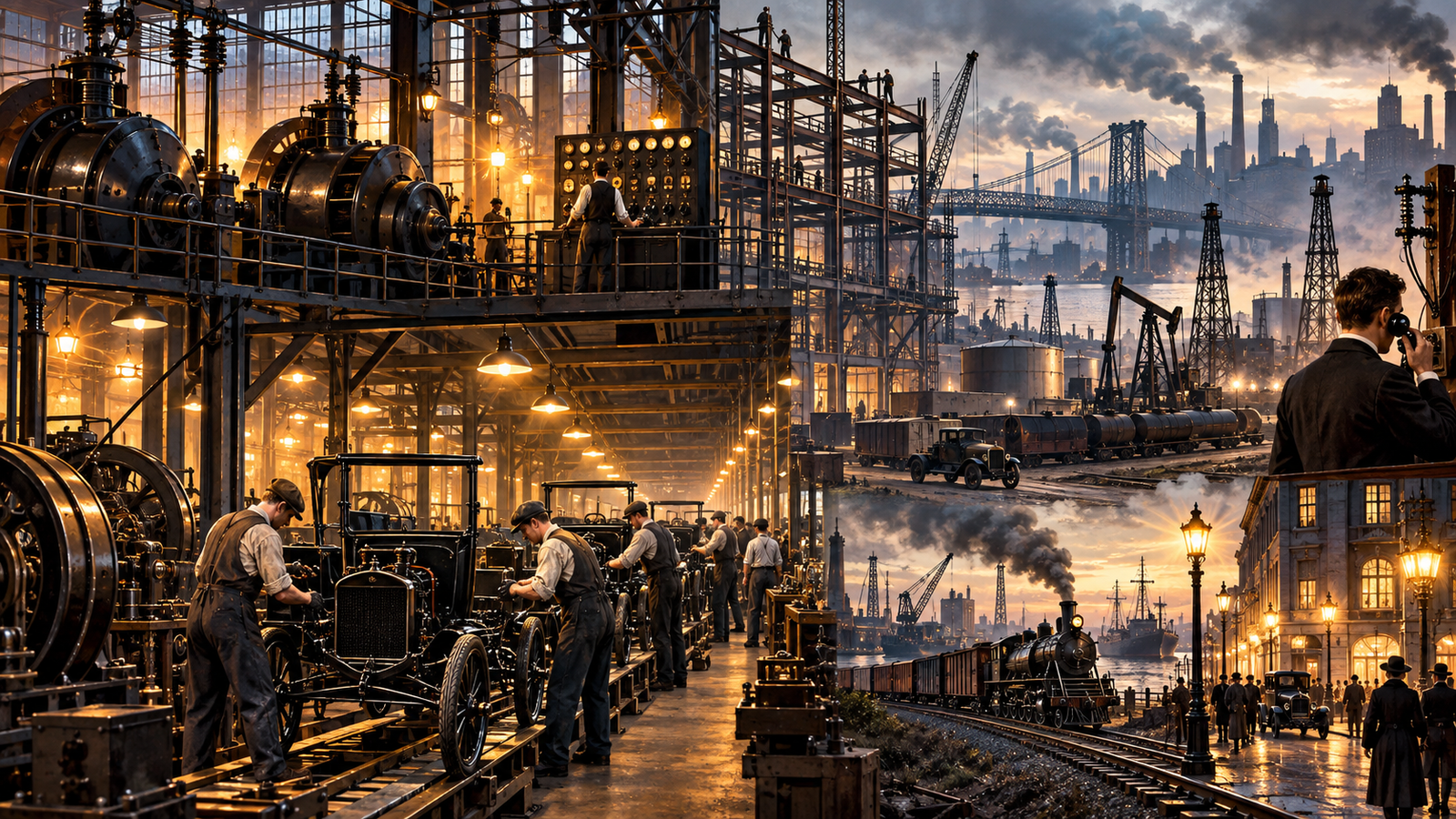
The next industrial revolution would change that.
Electricity would separate the machine from the shaft.
Steel would make enormous structures and machines increasingly practical.
Petroleum would provide concentrated energy for a new generation of engines.
The telephone would allow a human voice to cross distance almost instantly.
And mass production would turn the factory from a collection of machines into one enormous coordinated process.
The Second Industrial Revolution was beginning.
Steam Had Created a Powerful but Rigid Factory
The First Industrial Revolution had solved one of humanity’s oldest problems by creating controllable mechanical power.
But delivering that power throughout a factory remained awkward.
A large steam engine could drive a central shaft. That shaft could turn other shafts through belts and gearing. Those shafts could then power machinery positioned along the production floor.
The arrangement was ingenious, but it imposed its own architecture on industry.
Machines had to be positioned according to the requirements of the power system. Moving one machine could mean reconfiguring shafts, pulleys and belts. Mechanical energy was also lost as it travelled through this complicated network.
Then electric motors began changing the equation.
Instead of transferring mechanical motion from one central engine through an entire building, electricity could be carried through wires and converted back into motion precisely where it was required.
At first, electric motors often powered groups of machines. Eventually individual machines could have their own motors.
That seemingly modest change had enormous consequences.
Industrial historians have noted that electrical power eventually liberated factory planners from the restrictions imposed by long runs of mechanical shafting and pulleys. Engineers could increasingly arrange machine tools according to the production process rather than according to the location of the power source.
The factory was becoming configurable.
That would prove essential to mass production.
Electricity Was More Than a Better Source of Light
The transformation did not happen overnight.
Steam engines remained in use for decades, and in many cases steam itself was used to generate electricity. The new revolution did not simply replace one machine with another.
What changed was the way energy could be distributed and used.
In September 1882, Thomas Edison’s Pearl Street Station began supplying electricity to customers in lower Manhattan. It combined central generation, a distribution network and a practical commercial use for electricity in the form of lighting. The system was small by modern standards, but the basic architecture would become familiar everywhere. Electricity could be generated in one place and delivered to many users.
Lighting was only the beginning.
Factories could operate more safely and for longer periods. Streets could be illuminated. Shops and offices could remain active after sunset without relying entirely on gas lamps or candles.
Then electricity began powering motors.
That mattered even more.
A light bulb demonstrated that electricity could transform darkness into light.
An electric motor demonstrated that electricity could transform energy into work.
Once electrical systems expanded and alternating current made it increasingly practical to transmit power over greater distances, electricity began evolving from an invention into infrastructure.
A modern civilisation could now begin to organise itself around an energy network.
That distinction is important.
A steam engine is a machine.
An electrical grid is a system.
The Second Industrial Revolution increasingly belonged to systems.
Steel Gave the New Industrial Age Its Skeleton
Electricity alone could not have created the modern industrial world.
Industry also needed stronger materials in much greater quantities.
Steel had been known for centuries, but producing it was expensive and difficult at scale. During the nineteenth century, new manufacturing processes began changing that.
Henry Bessemer’s steelmaking process used air blown through molten iron to reduce its carbon content. It became the first widely viable method for producing steel in large quantities and helped make large amounts of steel available at more affordable prices.
The consequences spread far beyond steelworks.
More steel meant stronger rails.
Stronger bridges.
Larger ships.
More durable machines.
More ambitious buildings.
Larger factories.
Industrial civilisation was acquiring a new structural material.
And again, the technologies reinforced one another.
Railways created enormous demand for steel.
Steel improved railways.
Coal and iron fed industry.
Railways carried coal and iron.
Factories manufactured machinery.
Better machinery increased industrial production.
Electricity then made those factories more adaptable.
No single invention created the Second Industrial Revolution.
Its power came from technological convergence.
That same pattern will become important much later when we reach artificial intelligence.
AI is powerful partly because computing, data, telecommunications, cloud infrastructure and advanced semiconductors have converged around it.
Industrial revolutions happen when technologies stop developing separately and begin multiplying the effects of one another.
Communication Began Moving Faster Than People
There was another transformation occurring at the same time.
For most of human history, information could travel only as fast as something carrying it.
A letter moved at the speed of a horse, ship or train.
The telegraph had already begun breaking that relationship by allowing coded information to move through electrical signals.
The telephone went further.
Alexander Graham Bell received his telephone patent in March 1876. Days later, he successfully transmitted intelligible human speech over the device. Whatever later disputes surrounded the invention and its development, the underlying transformation was extraordinary. A human voice could now travel electrically between distant locations.
Distance had changed again.
The railway had made it possible to move people and goods much faster.
The telephone made it possible to move conversation without moving the people at all.
That had obvious social consequences, but it was also an industrial technology.
Factories could communicate with suppliers.
Businesses could communicate between offices.
Managers could coordinate operations across distance.
Markets could respond more quickly to information.
An industrial economy increasingly required communication networks alongside transport and energy networks.
The foundations of the connected world were beginning to appear.
Petroleum Put Industrial Power on Wheels
Steam locomotives had transformed transport, but the railway imposed another kind of constraint.
The locomotive could travel only where rails had already been laid.
The internal combustion engine offered a different possibility.
Instead of burning fuel outside an engine to create steam, fuel could be burned directly inside the engine itself. Gasoline and other petroleum products provided compact sources of energy that could travel with the machine.
The automobile would eventually become the most visible expression of this development.
By the early twentieth century, front engine vehicles driven by internal combustion had emerged as the dominant technological form for automobiles, and gasoline powered vehicles would dominate road transport for much of the century.
This changed more than personal travel.
Petroleum based transportation would eventually reshape cities, roads, logistics, agriculture, warfare and international politics.
It also created one of the defining industries of the twentieth century.
But before the automobile could transform society, manufacturers first had to solve another problem.
They had to find a way to make complicated machines in enormous numbers.
The Factory Learned to Produce at Scale
Henry Ford did not invent mass production.
Interchangeable parts, division of labour and specialised manufacturing processes had been developing long before Ford Motor Company existed.
What Ford and his engineers did was combine these ideas with extraordinary effectiveness.
At Ford’s Highland Park factory in 1913, production engineers began experimenting with moving assembly techniques.
Instead of having teams of workers remain around a product while it was assembled, the product increasingly moved past the workers.
Each worker performed a defined task.
Then the product moved to the next person.
And the next.
And the next.
The consequences were dramatic.
Historical records from The Henry Ford show that the evolving assembly system reduced the production time for a Model T from about twelve and a half hours under older stationary methods to approximately ninety three minutes as the process was refined.
The achievement was not principally that workers had learned to work faster.
The system had been redesigned.
That distinction matters.
Mass production worked by analysing a complicated activity, dividing it into smaller operations, standardising parts and arranging those operations in the most efficient sequence possible.
The worker no longer built the automobile.
The industrial system built the automobile.
Each worker contributed one part of the process.
This was a new way of thinking about production.
Standardisation Became a Technology of Its Own
For the assembly line to work, one part had to be capable of replacing another.
A bolt made in the morning had to fit where a bolt made in the afternoon would fit.
Components could not depend upon the individual craftsperson adjusting every piece by hand.
Precision and interchangeability therefore became essential.
The Model T contained thousands of components, and Ford’s production system required parts to be manufactured within sufficiently precise tolerances that they could move through the assembly process predictably.
The economic effect was enormous.
When production time fell, costs could fall.
When prices fell, more people could buy the product.
When more people bought it, demand increased.
Higher demand encouraged still greater production.
Mass production and mass consumption began reinforcing one another.
The factory was no longer simply producing goods.
It was helping create a mass market.
This relationship would define much of twentieth century capitalism.
Efficiency Changed the Worker Again
The First Industrial Revolution had moved many workers from workshops and homes into factories.
The Second Industrial Revolution changed their position inside the factory.
Mass production could make workers extremely productive, but it could also reduce complex occupations into narrowly repeated tasks.
A worker might spend an entire shift installing one component.
Then perform the same action again.
And again.
And again.
The machine no longer merely set the physical pace of work.
The production system increasingly determined the worker’s movement.
Ford discovered the human cost quickly.
Historical records show exceptionally high worker turnover after the introduction of the new assembly methods. The repetitive work was sufficiently unpopular that the company had to recruit enormous numbers of workers simply to maintain its workforce. Ford’s famous decision in 1914 to introduce a five dollar workday helped stabilise employment.
There was therefore a paradox at the heart of mass production.
The system could make each worker more productive while simultaneously giving the worker less control over the production process.
That tension remains with us.
Modern technology repeatedly promises to make work more efficient.
The important question is often who controls that efficiency.
Does technology make a worker more capable?
Does it make the worker more replaceable?
Or does it do both?
Modern Industry Was Becoming an Organised Network
By the early twentieth century, industrialisation looked very different from the world of the first steam powered mills.
Factories were increasingly electrified.
Steel supported larger machines, bridges and buildings.
Petroleum powered cars and new forms of transport.
Telephones connected businesses.
Railways moved enormous quantities of materials.
Corporations grew larger.
Industrial production increasingly required managers, engineers, accountants, sales networks, logistics systems and financial institutions capable of coordinating activity on a scale few earlier businesses had attempted.
The industrial corporation itself became a kind of technology.
It organised people, capital, information and machinery.
This may be the deepest legacy of the Second Industrial Revolution.
The First Revolution had shown that machines could multiply physical power.
The Second showed that technologies could be organised into systems capable of multiplying scale.
Electricity is the clearest example.
A single generator is useful.
Connect generators to transmission infrastructure, motors, factories, homes and cities and something fundamentally larger appears.
The same would later happen with computers.
One computer is a machine.
Billions of connected computers become the internet.
And the internet would ultimately help create the conditions for artificial intelligence.
Electricity Never Really Left the Centre of the Story
The Second Industrial Revolution feels distant because its defining technologies have become ordinary.
That is precisely how successful infrastructure disappears from view.
We do not normally think about an electrical revolution when we switch on a light.
We do not think about nineteenth century metallurgy when we enter a steel framed building.
We do not think about the history of mass production when we purchase a manufactured product assembled from standardised components.
The revolution succeeded so completely that its innovations became the background of modern life.
Even the technologies now presented as revolutionary remain dependent upon it.
A smartphone requires electricity.
A data centre requires enormous quantities of electricity.
Cloud computing requires electricity.
Semiconductor fabrication requires electricity.
Electric vehicles require electrical grids.
Artificial intelligence requires vast computational infrastructure that cannot operate for a second without reliable power.
The age of AI therefore has not replaced the age of electricity.
It has been built on top of it.
That is one of the most important things to understand about technological history.
Industrial revolutions accumulate.
The steam engine did not make human strength irrelevant.
Electricity did not make steam historically irrelevant.
Computers would not make electricity irrelevant.
Artificial intelligence will not make computing irrelevant.
Each revolution creates infrastructure on which the next one depends.
By the beginning of the twentieth century, humanity had learned how to generate power, distribute it, organise machines, standardise components, coordinate production and manufacture goods at extraordinary scale.
One critical limitation remained.
Machines could transform materials with remarkable efficiency.
But they still knew nothing.
They could not store information in a general form.
They could not follow changing instructions without being physically reconfigured.
They could not calculate, remember or process symbols in anything resembling the way modern machines do.
The next industrial revolution would begin changing that.
The machine was about to become programmable.
Next in The Trend Report
Computers Changed the Meaning of Machines
Digital Technology Turned Information Into Power
Resources
The historical account in this article was checked principally against the National Museum of American History material on industrial electrification, the United States Department of Energy’s historical material on electric power, the Science Museum Group collections on the Bessemer process, the Library of Congress collections on Alexander Graham Bell and the telephone, and The Henry Ford’s archival material on electrified factories, the Model T and the development of the moving assembly line.