A steam engine remained a steam engine, just as a mechanical loom remained a loom. An automobile might become faster, more reliable or more powerful, but it was still fundamentally a machine designed to perform a particular physical function.
Then humanity created a different kind of machine.
The computer did not have to be rebuilt every time its purpose changed. Give it one set of instructions and it could perform calculations; give it another and it could process payroll, analyse scientific data, play a game, edit a photograph or write a document. The physical machine could remain substantially the same even while the work it performed changed completely.
That was a profound break with much of technological history.
The First Industrial Revolution had multiplied human muscle, while the Second had organised power, machinery and labour into systems capable of producing at enormous scale. The Third Industrial Revolution would begin with a different resource altogether.
Information.
Computers transformed machines because they became increasingly programmable, while digital technology transformed information because words, numbers, photographs, sound and eventually almost every other form of human knowledge could be represented as data. Put those two developments together and the consequences were extraordinary.
The machine became general purpose, information became machine readable, and the foundations of the digital world were laid.
The Problem Was Information Before It Was Computing
Long before electronic computers appeared, industrial societies were already producing more information than people could comfortably process by hand. Governments counted populations, banks recorded transactions, railways tracked passengers and freight, insurance companies maintained customer records, factories monitored inventories and payrolls, and scientific institutions accumulated measurements in ever increasing quantities.
The more complex an industrial economy became, the more information it generated, and this created a problem that was not initially about computation in the modern sense. It was about how to organise, classify and process enormous quantities of records quickly enough for governments and businesses to use them.
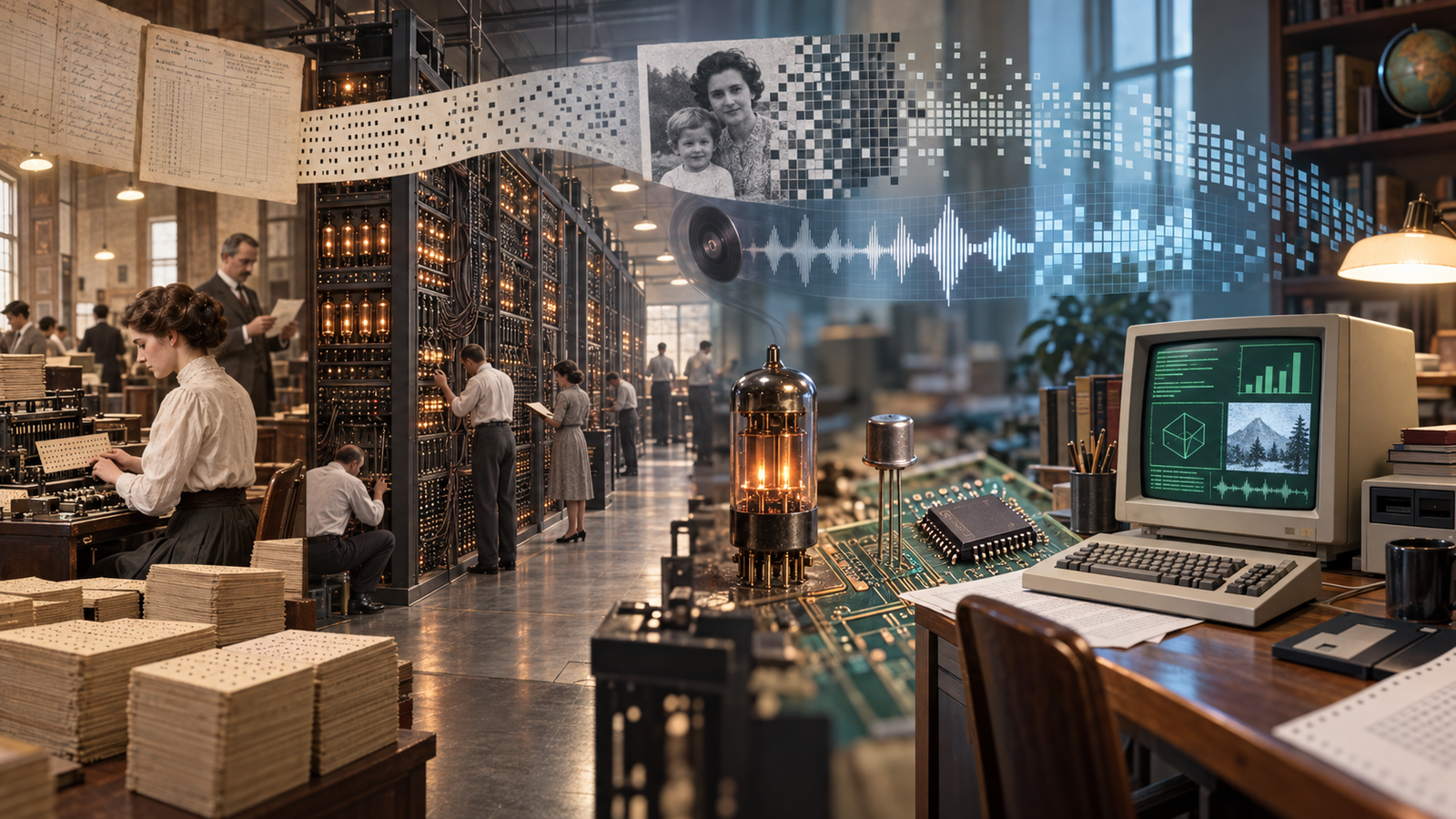
The United States Census provides a useful early example. By the late nineteenth century, population growth had made compiling census information increasingly difficult, so engineer Herman Hollerith developed an electromechanical system in which information could be represented by holes punched into cards and then counted and sorted by machines. His equipment was used on a large scale for the 1890 United States Census, and similar punched card systems later spread through government and business.
The important development was not simply that counting became faster. Information had begun to acquire a physical form that machines could read. A hole in a particular position could represent a fact, and once facts could be represented systematically, machines could sort, count and organise them.
The principle appears simple today, but it contained the beginnings of something much larger. Industrial society was learning that information itself could be processed mechanically.
A Machine Could Become More Than Its Mechanism
The idea of a general purpose computing machine appeared long before electronics made one practical.
During the nineteenth century, the English mathematician Charles Babbage designed what he called the Analytical Engine. It was never completed, but its design contained principles recognisable in modern computing, including separate mechanisms for calculation and storage together with a system for controlling operations through instructions. The machine represented an important conceptual transition from mechanical arithmetic towards general purpose computation.
Ada Lovelace saw something even more significant in Babbage’s design. In notes published in 1843, she described sequences of operations the machine could follow and considered the possibility that numbers processed by such a machine could represent things other than quantities.
Music was one example.
If relationships in music could be expressed according to rules and represented symbolically, Lovelace reasoned, then a machine might potentially manipulate those symbols as well. Her insight travelled far beyond arithmetic because it suggested that numbers did not necessarily have to mean numbers. They could represent letters, sounds, images, instructions or other forms of information.
The Analytical Engine was never built in Babbage’s lifetime, and the modern computer did not descend from it through a simple line of engineering development. Even so, the idea behind it was remarkable because it suggested that a machine might not have to be defined entirely by its physical mechanism.
Its behaviour could instead be defined by instructions.
The General Purpose Machine Became an Idea Before It Became a Reality
Almost a century later, Alan Turing approached the same fundamental problem from mathematics rather than engineering.
During the 1930s, Turing developed the theoretical idea of a universal computing machine capable, in principle, of carrying out the operations of other computing machines when supplied with the appropriate instructions. The importance of that idea is difficult to overstate because it separated the function of a machine from the particular physical form in which that function had traditionally been embodied.
Imagine having to manufacture a new machine for every new kind of calculation. Now imagine instead having one machine whose function could be changed simply by changing its instructions.
That is the conceptual foundation of general purpose computing.
Software had not yet become the enormous industry it would later be, but its defining principle was already taking shape. The instructions were becoming as important as the machine itself.
War Accelerated the Electronic Computer
The Second World War created an enormous demand for calculation. Military organisations needed ballistic tables, scientists required increasingly complex mathematical work, and intelligence services confronted sophisticated encryption systems whose analysis demanded speed and accuracy beyond what manual methods could reasonably provide.
The urgency of wartime problems accelerated work on electronic computing on both sides of the Atlantic.
In the United States, ENIAC became one of the most famous early electronic computers. Built between 1943 and 1945, it used almost 18,000 vacuum tubes and occupied more than 1,000 square feet. It could perform calculations at electronic speeds and was enormously faster than many of the electromechanical systems that preceded it.
Yet ENIAC also demonstrated an important limitation. Changing the task could require operators to reconfigure switches and cables, which meant that programming the machine remained partly a physical activity. Once configured, the computer could calculate quickly, but preparing it for a different problem could take considerable time.
That limitation pointed towards one of the defining principles of modern computing.
Instead of physically rewiring a machine whenever its task changed, the instructions themselves could be stored inside the machine.
Software Separated the Machine From Its Purpose
The stored program concept transformed computing because it allowed instructions to be represented electronically and placed in memory alongside data. The machine could retrieve those instructions, execute them and then proceed automatically to the next one.
In June 1948, the experimental Manchester Small Scale Experimental Machine, better known as the Manchester Baby, successfully ran a program stored in its electronic memory and demonstrated that the concept worked in practice.
This changed what a machine could be.
A traditional industrial machine often embodied its purpose in its physical design, but the stored program computer increasingly embodied purpose in software. Change the program and the machine changed, even though the underlying hardware remained substantially the same.
That separation between hardware and software would eventually create entire industries. Computer manufacturers could build machines, software developers could build capabilities for those machines, and users could acquire new functions without replacing the entire physical system.
The machine was no longer simply manufactured for a task. It could be programmed for one.
Information Became Something That Could Be Measured
Another intellectual breakthrough appeared at almost exactly the same moment.
In 1948, Claude Shannon published A Mathematical Theory of Communication while working at Bell Telephone Laboratories. Shannon treated information in a radically useful way by showing that, for the purposes of communication engineering, information could be measured mathematically without first having to understand its meaning.
The basic unit became the binary digit or bit, representing a choice between two possible states.
The profound consequence was not that human beings suddenly began thinking in zeros and ones. It was that information of extraordinary complexity could be represented through combinations of simple states. Text could be encoded, numbers could be encoded, sound could be encoded, and images could be encoded.
Once represented digitally, all of them could potentially be stored, manipulated and transmitted by the same underlying type of machine.
The distinction between a photograph and a page of writing remains obvious to a human being. To a digital computer, however, both can ultimately become data.
That changed the history of information.
The Computer Began to See the World as Data
In 1957, engineer Russell Kirsch and colleagues at what is now the United States National Institute of Standards and Technology asked whether a computer could process a picture.
They built a rotating drum scanner and used it to feed a photograph into the SEAC computer. The image showed Kirsch’s infant son and measured only 176 pixels by 176 pixels, making it tiny and crude by modern standards, yet the experiment demonstrated something far larger than the photograph itself.
An image could become numbers.
Once the photograph existed as digital information, a computer could process it. That experiment helped establish the field of digital image processing and contributed to later technologies ranging from medical imaging and satellite observation to digital photography.
This was the deeper revolution. Computers were no longer becoming merely better machines for arithmetic; more of the world was becoming representable in forms that computers could manipulate.
As the boundary of what could become data expanded, so did the boundary of computation itself.
The Transistor Made the Computer Smaller
Early electronic computers had one obvious problem.
They were enormous.
Vacuum tubes consumed substantial amounts of electricity, generated considerable heat and eventually failed, which meant that computers could perform remarkable work only at significant financial and physical cost.
The transistor changed that.
In 1947, John Bardeen and Walter Brattain demonstrated the first point contact transistor at Bell Laboratories, while William Shockley subsequently developed the junction transistor. Their semiconductor work would later earn the three scientists the 1956 Nobel Prize in Physics.
Transistors could perform essential electronic switching and amplification functions while being much smaller and consuming less power than vacuum tubes, so computers began shrinking even as their capabilities expanded.
But success created another engineering problem. As circuits became more complex, individually wiring increasing numbers of transistors became increasingly difficult to manage.
The answer was integration.
The Circuit Disappeared Into the Chip
In 1958, Jack Kilby at Texas Instruments demonstrated a circuit in which multiple electronic components were fabricated from semiconductor material. Soon afterwards, Robert Noyce at Fairchild Semiconductor developed a practical approach to connecting components on a single silicon chip using the planar manufacturing process.
Together, developments such as these helped establish the integrated circuit.
Instead of constructing an electronic system by wiring large numbers of separate components together, increasingly complex collections of components could be manufactured within a tiny piece of semiconductor material. Circuits could become smaller, more reliable, cheaper to reproduce and vastly more complex.
The transformation was dramatic. What had once required cabinets could eventually fit on a board, and what required boards could eventually fit on a chip.
Then came the microprocessor.
By the beginning of the 1970s, engineers were integrating the central processing functions of computers onto increasingly small numbers of chips. Intel’s 4004, introduced in 1971 as part of a chipset, became an important early commercially produced single chip CPU and a symbol of the arrival of the microprocessor age.
The consequences would soon escape laboratories and large institutions.
Computing was about to become personal.
The Computer Moved From the Institution to the Individual
For much of the early computer age, computers belonged to governments, universities, banks, military institutions and large corporations. They were expensive machines operated by specialists and were largely inaccessible to ordinary individuals.
The microprocessor changed the economics.
During the 1970s, smaller computers became affordable enough for hobbyists and eventually ordinary consumers. The Altair 8800, introduced in 1975, became one of the machines that helped ignite the American personal computer movement. It was primitive by modern standards and required considerable technical knowledge, but it demonstrated that computing no longer had to belong exclusively to institutions.
Then machines such as the Apple II arrived in 1977 with a much clearer proposition. The computer could become an everyday product that sat in a home, school, small business or office.
The Apple II combined approachable hardware with an expanding range of software, and the arrival of applications such as the VisiCalc spreadsheet showed why personal computing mattered beyond enthusiasts. VisiCalc allowed users to manipulate financial information electronically, so that changing one value could automatically update related calculations.
The computer was no longer merely performing arithmetic faster than a person using a calculator. It was changing the way people worked with information.
That distinction would define the coming decades.
Software Made One Machine Into Many
Personal computing revealed the true power of programmability because the same physical machine could perform entirely different roles depending on the software installed on it.
A computer could become a word processor, spreadsheet, accounting system, drawing tool, game machine, engineering workstation or database. Hardware provided computational capability, while software translated that capability into useful work.
This created an entirely new relationship between consumers and machines.
Buying a mechanical typewriter gave you a typewriter, and buying a calculator gave you a calculator. Buying a computer, by contrast, gave you a machine whose future uses were not necessarily known when you bought it because new software could create new functionality years after the hardware had left the factory.
IBM’s entry into the personal computer market in 1981 helped push this transformation deeper into corporate life. Businesses increasingly placed computers on individual desks while a growing software industry supplied applications for word processing, spreadsheets, databases and other forms of office work.
The programmable machine had become an economic platform.
Digitisation Changed More Than Computers
As computers spread, activities that had previously existed in physical or analogue forms began moving into digital systems.
Documents became computer files, business accounts became databases, engineering drawings became digital designs, photographs became arrays of pixels, sound could be sampled and represented numerically, and records that had once occupied filing cabinets could increasingly be stored magnetically and later electronically.
The importance of this transformation is easy to underestimate because digital information now surrounds us, but the economics of information are radically different from the economics of physical objects.
If a manufacturer wants to produce another automobile, it requires more steel, rubber, glass, energy, labour and transportation. If a computer already contains a digital file, however, producing another identical copy may require almost no additional material, and the copy can be perfect.
Digital information can also be searched, sorted, rearranged, analysed, compressed, copied and eventually transmitted almost instantly.
The industrial revolutions had previously taught humanity how to reproduce physical goods at enormous scale. The digital revolution began teaching humanity how to reproduce and manipulate information at enormous scale.
Information Became an Economic Resource
Once organisations began digitising their activities, they also began producing increasing quantities of data.
A bank transaction could become a digital record, a company’s inventory could become a database, a scientific instrument could generate digital measurements, a payroll system could store detailed information about employees, and retailers could begin recording purchases computationally.
The more economic activity entered computers, the more information those activities generated.
This created a new form of organisational power because businesses that could process information quickly could understand their operations more accurately, governments could analyse larger datasets, scientists could model systems too complex for hand calculation, engineers could test designs computationally and financial institutions could process transactions at enormous scale.
Computational power and informational power were becoming intertwined.
The computer had begun as a machine for calculation. It was becoming a machine for organising knowledge.
The Machine Had Changed and So Had Information
The Third Industrial Revolution cannot be explained simply by saying that computers became faster. Speed mattered enormously, as did miniaturisation and falling costs, but the deeper change was conceptual.
Computers changed what machines could be, while digital technology changed what information could be.
The machine became programmable, the program itself became information, and words, pictures, records and sounds increasingly entered the same digital environment.
This is why the computer was unlike the industrial machines that preceded it.
A steam engine multiplied power, and an assembly line multiplied production. A computer could multiply something less tangible but increasingly important: the ability to manipulate information.
Once information could be represented digitally, the limits of the computer expanded with every new thing society learned to convert into data.
That transformation created the foundation of the modern economy, but one enormous step was still missing.
Computers could calculate, store information, run software and sit on millions of desks, yet much of their information remained trapped inside individual machines or private computer systems.
The next transformation would occur when those machines began talking to one another.
Once computers became connected, information no longer had to remain where it was created. It could move between machines, organisations and eventually continents. When billions of computers ultimately joined interconnected networks, the digital revolution would become something far larger than anyone building the first room sized computers could reasonably have imagined.
The machine had become programmable.
Information had become digital.
Now the world was about to become connected.
Next in The Trend Report
The Internet Connected the World
Global Networks Created the Digital Economy
Resources
This article draws principally on the Computer History Museum’s collections on Charles Babbage, Ada Lovelace, early electronic computers, stored program computing, semiconductor technology and personal computing; the Science Museum Group’s Babbage archive; the Smithsonian National Museum of American History’s collections on punched card data processing and personal computing; the National Institute of Standards and Technology’s history of early digital imaging; Nobel Prize historical material on the transistor; and IEEE historical material on Claude Shannon and information theory.