
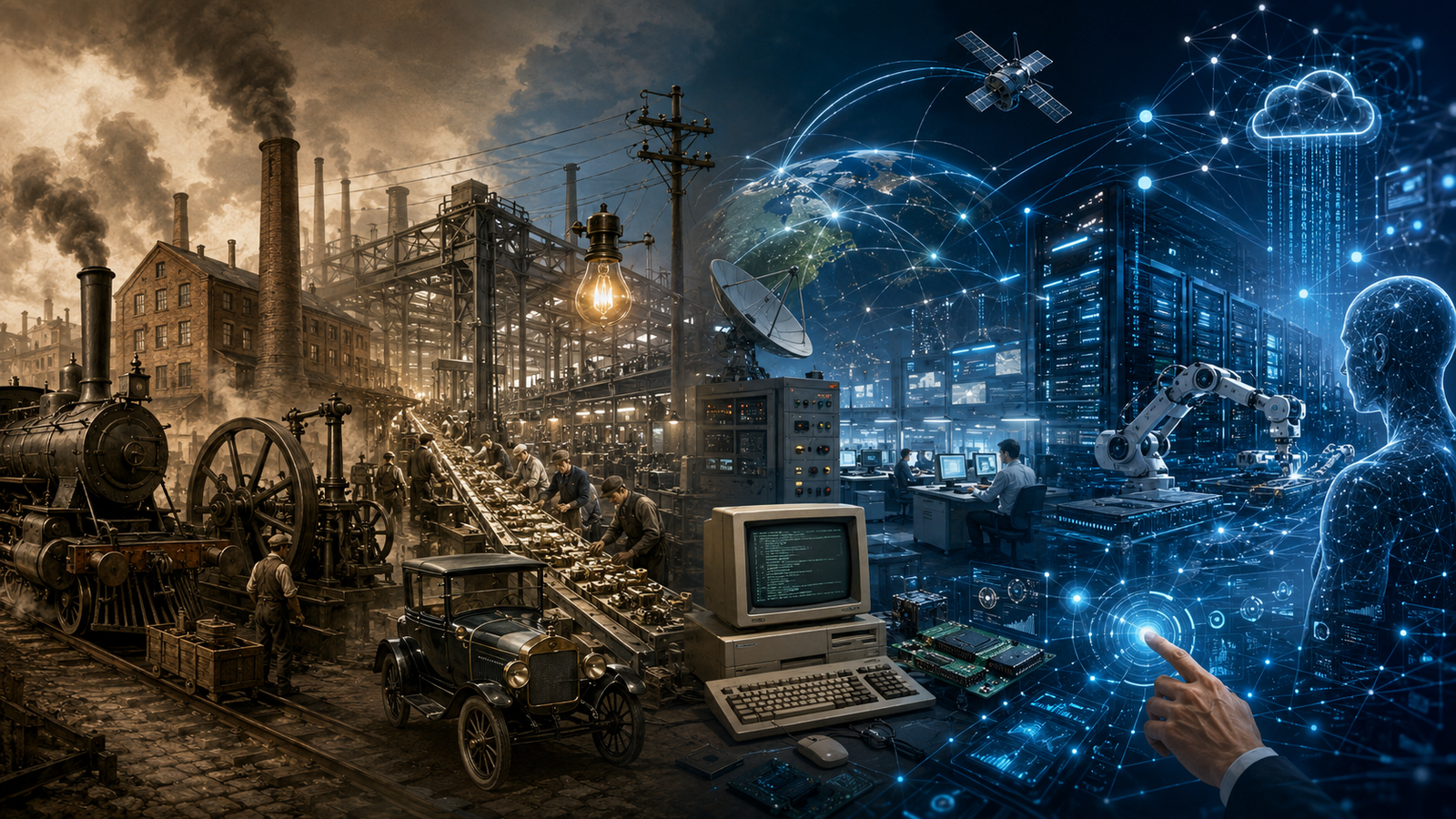
Human history can, in many ways, be read as a history of tools.
The earliest tools extended the reach of the human hand. The wheel allowed people to move heavier loads. Agriculture multiplied the productivity of land and labour. Writing allowed knowledge to survive beyond the memory of a single generation. Printing multiplied the reach of ideas. Navigation opened oceans. Mechanical clocks imposed precision on time. Each of these technologies changed what human beings could do, but only occasionally have technological changes arrived with such force that they reorganised entire societies.
Those moments are what we have come to call industrial revolutions.
They are not defined by the arrival of a single machine. They occur when several technologies mature and converge, transforming production, labour, transport, communication and economic power at the same time. They change not merely the tools people use, but the structure of everyday life.
Over the last two and a half centuries, humanity has passed through three such transformations and is now living through a fourth.
The first gave machines power.
The second gave industry scale.
The third gave society digital information.
The fourth is beginning to give machines something that looks increasingly like intelligence.
That final development may make the present industrial revolution different from all those that came before it.
The First Industrial Revolution: When Machines Multiplied Muscle
Before the eighteenth century, the limits of production were largely the limits of human, animal and natural power. People could build ingenious machines, but those machines still depended heavily on muscles, flowing water, wind or animals.
The First Industrial Revolution changed that equation.
Beginning in Britain in the second half of the eighteenth century, developments in steam power, coal, iron production and mechanised textiles transformed manufacturing. Steam engines made it possible to generate mechanical power in quantities that no group of human labourers could match. Factories concentrated workers and machinery under one roof. Railways eventually moved people and goods at speeds and volumes previously unimaginable.
The transformation was fundamental.
For most of history, increasing production generally meant adding more labour. Industrialisation introduced another possibility: increasing the power of machines.
A machine did not tire in the same way a human being did. It did not require the same number of workers to produce the same quantity of goods. It could operate with a consistency and force that manual labour could not reproduce.
The industrial economy was born.
But industrialisation did not simply make things faster. It reorganised society. People moved from rural communities into growing industrial cities. Cottage industries declined. Factory owners accumulated enormous economic power. A new urban working class emerged. Railways compressed distance, making it possible to move raw materials and finished goods through expanding national and international markets.
The gains were extraordinary, but so were the disruptions. Factories were often dangerous. Child labour was widespread. Industrial cities struggled with overcrowding, disease and pollution. Skilled workers sometimes saw machines destroy occupations that had supported families for generations.
Even at the beginning of industrialisation, therefore, the central tension of technological progress was already visible.
Technology could create wealth while simultaneously displacing people.
That tension has never disappeared.
The Second Industrial Revolution: When Industry Learned to Scale
If the First Industrial Revolution mechanised production, the Second Industrial Revolution industrialised scale.
From the late nineteenth century into the early twentieth century, a new cluster of technologies transformed industrial society again. Electricity, steel, petroleum, chemicals, the internal-combustion engine, the telegraph and telephone reshaped both factories and daily life.
Electricity was particularly important.
Steam engines had brought enormous mechanical power into factories, but electricity allowed that power to be distributed with much greater flexibility. Machines no longer had to be arranged around large central systems of mechanical transmission. Factories could be reorganised, expanded and operated with increasing efficiency.
Then came mass production.
Assembly-line systems divided complex manufacturing processes into simpler, repeated tasks. The automobile became one of the defining products of the age, but the deeper transformation was methodological: industrial production could now take place at enormous scale.
Goods that had once been expensive or rare became accessible to much larger populations.
Electric lighting changed the rhythm of cities. Telephones made immediate long-distance communication possible. Cars transformed movement. Steel reshaped architecture and infrastructure. Petroleum powered an expanding transportation system.
The world was becoming not only more industrial, but more connected.
A useful pattern begins to emerge here.
The First Industrial Revolution reduced the limits imposed by physical labour.
The Second reduced the limits imposed by scale and distance.
The Third would begin attacking another limitation altogether: the difficulty of processing information.
The Third Industrial Revolution: When Information Became Digital
The computer did not arrive with smoke pouring from a chimney or the sound of a steam engine, but its effect on civilisation was just as profound.
The development of the transistor, semiconductor, integrated circuit and modern computer created the technological foundations of the Third Industrial Revolution.
For the first time, machines could process enormous quantities of information electronically.
Early computers were large, expensive and limited to governments, universities and major corporations. Over time, however, computing power became smaller, cheaper and more widely available. Mainframes gave way to personal computers. Personal computers became connected through networks. Those networks eventually became the internet.
Then computing moved into the pocket.
The smartphone combined a computer, camera, navigation system, telecommunications device, marketplace, newspaper, entertainment centre and gateway to the internet in an object carried by billions of people.
This revolution changed the nature of information itself.
A document was no longer merely a physical object. A photograph was no longer necessarily a piece of film or printed paper. Music no longer required a record, cassette or compact disc. Money increasingly became electronic data. Communication could cross continents almost instantly.
Information became digital, searchable, replicable and globally connected.
Businesses that understood this new environment grew with astonishing speed. Entire industries were disrupted. Newspapers lost classified advertising to online platforms. Music distribution moved onto the internet. Retail moved online. Banks digitised transactions. Social networks emerged. Software became embedded in almost every serious industry.
Yet the Third Industrial Revolution was preparing the world for something even more consequential.
Every digital transaction produced data.
Every search, photograph, purchase, message, video, location record and online interaction added to an expanding digital universe.
At the same time, computing power continued to increase.
These two developments — enormous amounts of data and enormous amounts of computing power — created the conditions in which modern artificial intelligence could rapidly advance.
AI did not appear out of nowhere.
It stands on top of the technological architecture created by the revolutions that preceded it.
The Fourth Industrial Revolution: When Machines Begin to Learn
The Fourth Industrial Revolution is broader than artificial intelligence.
It includes robotics, advanced sensors, the Internet of Things, cloud computing, biotechnology, autonomous systems, additive manufacturing, advanced semiconductor technologies and interconnected cyber-physical systems.
But artificial intelligence increasingly sits at the centre of this technological ecosystem.
A robot becomes much more useful when it can interpret its environment.
A vehicle becomes something fundamentally different when software can recognise pedestrians, road markings and surrounding traffic.
Medical databases become more powerful when algorithms can identify patterns across millions of records.
Factories become more adaptive when machines can detect faults before they occur.
Software changes again when software can help create software.
The defining transition is therefore not simply from analogue technology to digital technology.
It is from digital systems that process information to systems that can increasingly learn from it.
Modern AI can recognise objects in photographs, translate languages, generate images, analyse documents, write computer code, recommend medical possibilities, detect financial fraud, predict consumer behaviour and hold sophisticated conversations.
These systems remain machines. They make mistakes. They require human-designed infrastructure, data, energy and objectives. Their apparent intelligence should not be confused with human consciousness.
But the economic significance of what they can already do is difficult to overstate.
Previous industrial revolutions largely changed how human beings performed physical work.
AI is entering the domain of cognitive work.
That is the distinction that makes the present moment so important.
From Automating the Hand to Automating the Mind
A steam engine could replace an enormous amount of physical labour, but it could not draft a legal argument.
An industrial robot could weld thousands of identical joints, but it could not ordinarily explain the engineering principles behind them.
A calculator could perform arithmetic faster than any human being, but it could not ordinarily interpret the context of a question and decide how to answer it.
AI systems are beginning to cross some of these boundaries.
They can draft. Analyse. Translate. Summarise. Design. Predict. Generate. Classify. Recommend.
This does not mean they can perform every intellectual task better than people. Nor does it mean human judgement is becoming irrelevant.
It means something more precise and perhaps more consequential: tasks once believed to require human cognition are increasingly becoming technically automatable.
That places lawyers, accountants, writers, teachers, programmers, designers, analysts and other knowledge workers inside the technological debate in a way previous industrial revolutions often did not.
The factory worker has long understood what automation can mean.
The office worker is beginning to discover it.
The Machine That Helps Build the Next Machine
There is another reason AI may be fundamentally different.
Earlier machines were overwhelmingly the products of human invention.
AI is increasingly becoming an instrument of invention itself.
Researchers use machine learning to search for new materials. Pharmaceutical scientists use computational systems in drug discovery. Engineers use AI-assisted tools in design. Programmers use AI to generate and debug software. Scientists use it to analyse datasets too large for any individual human being to meaningfully inspect.
Technology is therefore beginning to participate in the process that creates new technology.
This creates the possibility of a powerful feedback loop.
Human knowledge produces better artificial intelligence.
Better artificial intelligence assists researchers and engineers.
Those researchers produce better technologies.
Those technologies contribute to still more capable computational systems.
If that cycle accelerates, then the Fourth Industrial Revolution may not simply introduce another generation of machines. It may increase the speed at which future generations of technology are created.
That would be historically significant.
We Have Been Afraid of Machines Before
None of this means that predictions of technological catastrophe should automatically be accepted.
Every industrial revolution has created fear.
Workers resisted mechanised textile equipment during the First Industrial Revolution. Agricultural machinery displaced enormous amounts of manual labour. Assembly lines changed manufacturing employment. Computers transformed clerical work. Industrial robots reduced the need for some factory occupations.
Yet new industries also emerged.
The automobile destroyed some occupations associated with horse-drawn transport while creating enormous industries around manufacturing, petroleum, roads, repair, insurance and logistics.
Computers eliminated certain clerical tasks while creating software engineering, cybersecurity, digital design, online commerce and industries that previous generations could scarcely have imagined.
History therefore warns against simplistic predictions.
Technology does not merely destroy jobs.
Nor does it automatically create equally good replacements for everyone affected.
It reorganises economic value.
Some skills become less valuable. Others become more important. Some firms disappear. Others dominate entire industries. Some workers gain extraordinary opportunities. Others experience serious displacement.
The central question of the AI age is whether this historical pattern will repeat — or whether the breadth of cognitive tasks that AI can potentially automate makes this transformation different in scale and speed.
The Question Before Us
Industrial revolutions are rarely understood clearly while they are happening.
People living through the age of steam did not know exactly where industrialisation would lead. Those witnessing the arrival of electricity could not fully anticipate modern cities. The pioneers of early computing did not foresee a world in which billions of people would carry internet-connected computers in their pockets.
We are in a similar position today.
Artificial intelligence may be overhyped in some respects and underestimated in others.
What is increasingly difficult to dispute is that it represents a new stage in humanity’s relationship with machines.
The First Industrial Revolution taught us to mechanise power.
The Second taught us to industrialise production.
The Third taught us to digitise information.
The Fourth is teaching machines to use that information in increasingly sophisticated ways.
Over the coming weeks, The Trend Report will follow this history in greater depth: from steam and electricity to computers, the internet, artificial intelligence, robotics, work, law, education, medicine, business and the geopolitical struggle over the technologies that may define the century.
We will also ask a question of particular importance to Africa: will the continent participate primarily as a consumer of the technologies of the Fourth Industrial Revolution, or can it become a meaningful producer, developer and owner of them?
The history of technology is not ultimately a history of machines.
It is a history of what happens to human society when the limits of machines change.
And that is why the present revolution deserves particularly close attention.
For centuries, our machines primarily multiplied what our bodies could do.
Now they are beginning to perform tasks associated with what our minds can do.
The defining question of the Fourth Industrial Revolution may therefore not simply be, What can this new machine do for us?
It may be:
What happens to human society when machines begin doing things we once believed required a human mind?









One Response
#thetrendreport